
Kernersville Previous Residents by Era
Trace Kernersville previous residents one address at a time. Begin with the parcel and work backward through the record type that matches the era. The date span matters as much as the name. The Register of Deeds has instruments from Forsyth County's 1849 formation, but the office advises that current online image coverage should be confirmed. Digital NC confirms particular 1960 and 1962 directories, not an uninterrupted run. Archives and library sources supply the older fallback.
| Source | Confirmed years or era | Where held | What it can show |
|---|---|---|---|
| Forsyth ROD/BIS | Some instruments from 1849; online coverage varies by record type | ROD online, counter, mail, or e-file | Recorded parties, instrument, date, book or page, and image where available |
| Hill's Kernersville directory | 1960 | Digital NC and library access | Dated street, householder, telephone, and period notation |
| Hill's Kernersville directory | 1962 | Digital NC and library access | Household, address, neighbor, and ownership-context prompts |
| Kernersville High School Retrospect | 1940 | Digital NC and Forsyth Library | School-community and classmate-era context |
| Forsyth miscellaneous records | 1849-1954 | NC State Archives | Older county material and a route to request copies |
Use the modern parcel first when the house is known now. Use the dated directory first when the question begins with an older street number or household name. Neither source is a statement about who lives at the address today.
Kernersville Parcel Starting Point
For a Kernersville house history, Forsyth Tax and GIS provide the address key that holds the later records together. Detailed Property Information searches Owner or Business Name, Location Address, REID, and PIN. The Parcel Viewer searches Owner Name, Parcel Number, REID, Official Address, and Block and Lot. Save the official address and the exact PIN or REID before moving to BIS. A percent wildcard and street-type abbreviations can help when an old address is incomplete.
The property record's current-owner field is the first clue, not the final conclusion. A situs address identifies the land, while a mailing address receives tax notices. They can be different. The property map is a reference layer, not a legal survey. For an ownership question, compare the map with the recorded deed and its legal description.
Kernersville Deed Search Mechanics
Forsyth BIS is the instrument search behind a Kernersville previous-residents trail. It supports grantor or grantee names, entity and party type, standard, full-text, and sounds-like modes, categories, date ranges, book and page or file numbers, sorting, and alphabetical browse. Use the present parcel record to find the recorded name. Open the matching deed, then keep the instrument type, recording date, parties, and book or page together in notes.
Forsyth ROD also accepts office, mail, and e-file channels for its work. When a historic image is not exposed by an online result, ask the office about the relevant book, page, or instrument rather than assuming the record is unavailable.
The Forsyth ROD online-lookup page is the official entry point for its BIS choices.
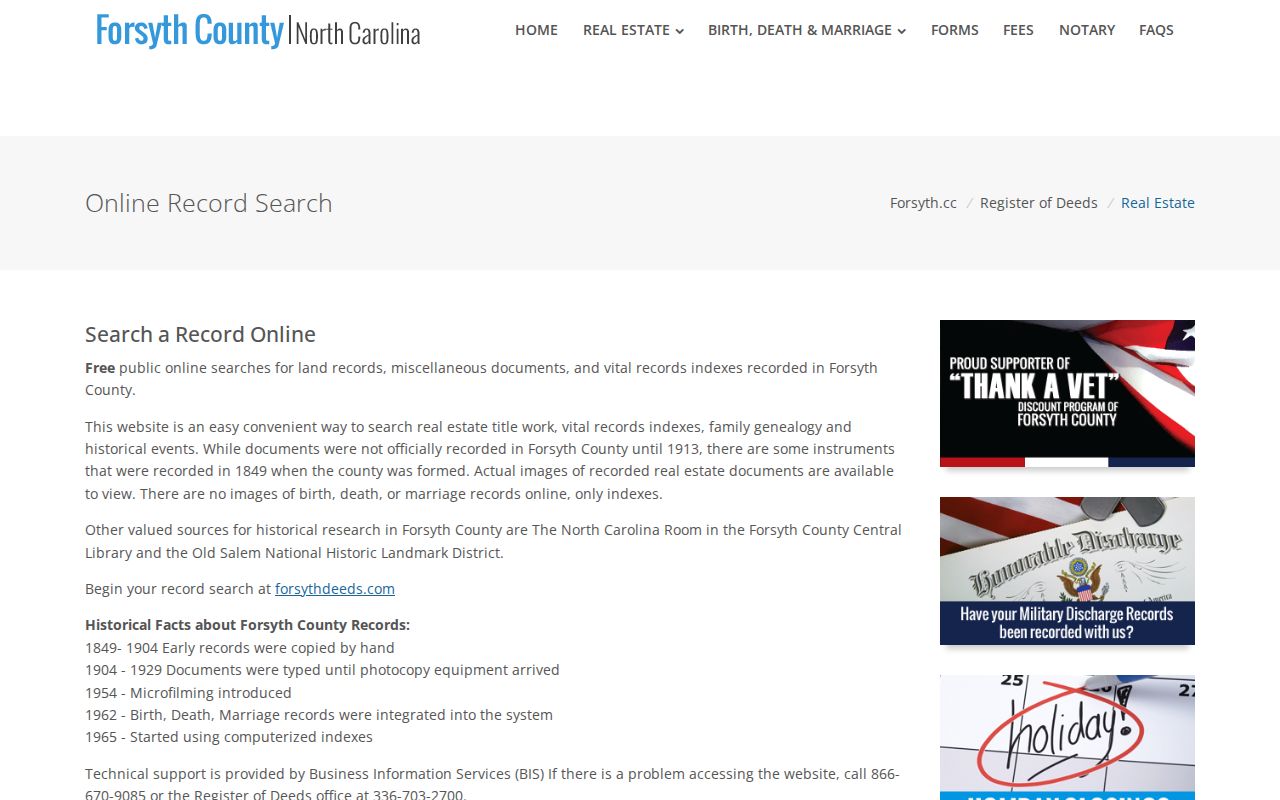
The online-lookup view helps separate land and index research from vital-record requests, which have different access rules.
Trace Kernersville Past Deed Chains
A deed chain is the recorded sequence of transfers for the same land. Start with the present parcel and current deed, then turn the prior grantee into the next grantor search. Follow the legal description as carefully as the street address. Deeds of trust, satisfactions, easements, restrictive covenants, plats, and rights-of-way can alter what appears to be a simple ownership sequence. Stop when the requested era is reached and preserve any unresolved gap.
- Find the current parcel through Tax, copy its PIN or REID, and note its situs address.
- Locate the latest recorded deed in BIS and record the grantor, grantee, date, instrument, and book or page.
- Search the earlier grantee as a grantor to locate the preceding transfer.
- Compare the legal description and plat references at each step so that similarly named streets do not join the wrong parcel.
- Move to the ROD counter, library, or Archives when the needed record falls outside the online layer or needs a different custodian.
- Grantor and grantee
- The party conveying an interest and the party receiving it in a recorded instrument.
- Chain of title
- The sequence of recorded transfers and related instruments for the same parcel.
- Legal description
- The land description in the deed, often more durable than a street number for connecting older records.
Kernersville Oakhurst Address Bridges
Old address spelling is a real obstacle when looking for Kernersville previous residents. Oakhurst Street and Oakhurst Drive were consolidated as Oakhurst Street by an April 6, 2010 Town resolution for emergency-response accuracy. Search both versions in historical directories and deeds, save the form printed in each source, and test the current equivalent only after the original result is preserved.
Town addressing standards also describe directional prefixes, street types, and renaming after road closure or realignment. Forsyth's road-name history work is another route when a familiar street seems to vanish. A change in label or numbering is often a better explanation than a hasty conclusion that a past household moved.
Kernersville Past Household Pairing
Deeds trace recorded parties, not every household. To look for who lived here before, open the 1960 or 1962 Kernersville directory at the original street spelling and number. The 1960 volume puts numbered streets in numerical order, named streets alphabetically, and names opposite addresses. It also marks intersecting streets and may include period owner or tenant notation. The 1940 Retrospect is a separate school-community source, not an address directory.
Pair a directory edition with another dated source, such as a recorded deed, tax record, newspaper result, or census lead. The library newspaper index can provide date, paper, section, page, and article for five local papers. A death, estate, or probate question should move to the Clerk, local or state vital channel, or Archives only where the access rule supports it. The source collections are described in more depth through the Kernersville city directories route.
Use a simple sequence: address form → directory year and page → dated corroborating record → source label. That keeps a previous-residents result attached to its time period.
Kernersville House History Context
House history can include more than a transfer list. Paddison Memorial Library offers public computers and librarian assistance in historic downtown Kernersville, while the North Carolina Collection maintains newspapers, government information, photos, and local-history resources. Its photo holdings include people, events, buildings, and street scenes from the late 1800s forward. These are useful channels for the story of a place, not proof that a modern person belongs to it.
Library of Congress documentation for Korner's Folly at 271 South Main Street is a local example of a built-history route. Its HABS record supplies photographs, drawings, and data pages for a 22-room historic house. A careful house-history sequence can combine that sort of documentation with library photos, newspapers, deeds, and the parcel record without turning an old owner or subject into a current occupant.
See the Forsyth ROD real-estate information for the office's historical and online-image context.
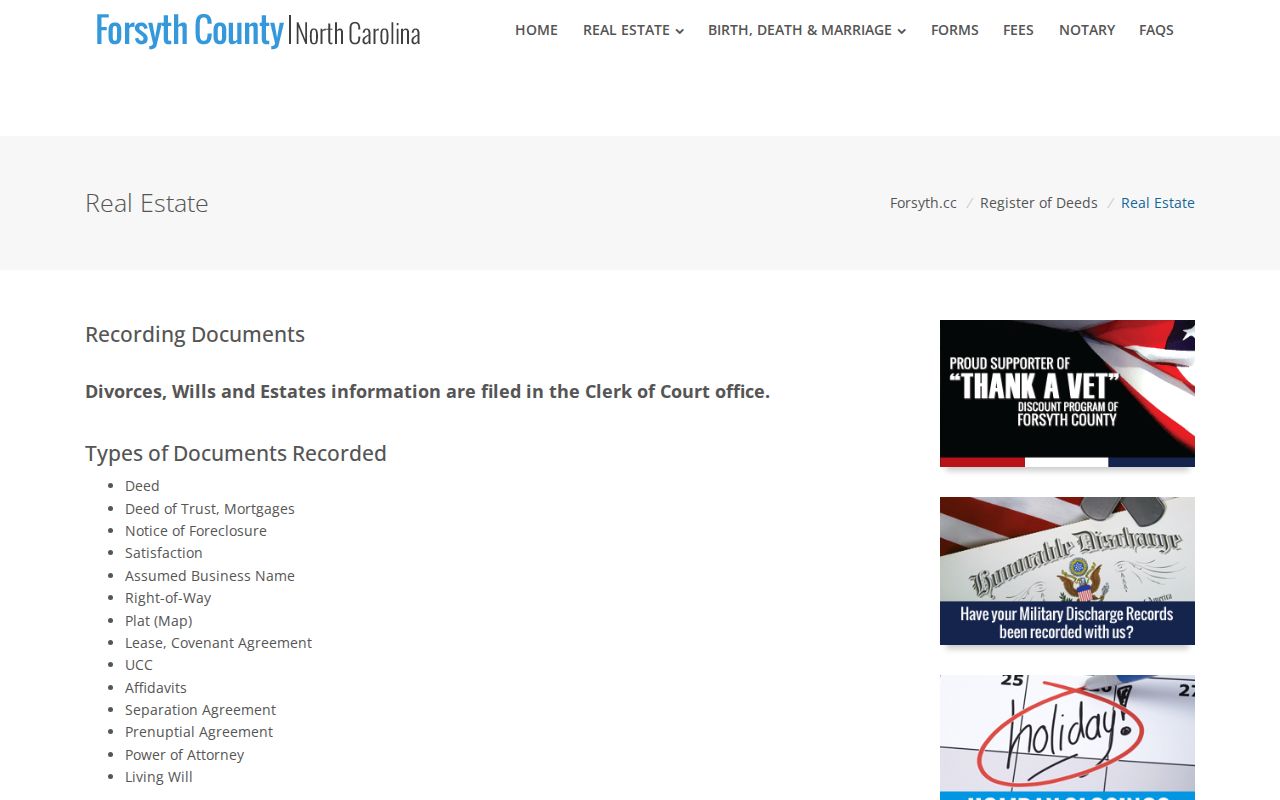
The real-estate information page gives the Register of Deeds context for moving from a property clue to recorded history.
Kernersville Archives Fallback
When a prior-residents search reaches beyond the online record, use the fallback chain that matches the record type. Forsyth Library and Digital NC can supply local directory, newspaper, photo, and microfilm leads. The State Archives catalog and copy form can route requests for county land, estate, court, marriage, tax, will, bond, census, and miscellaneous materials. Its Forsyth miscellaneous collection covers 1849 to 1954, while broader county collections carry their own dates and limits.
An Archives request works best when it identifies a person, county, year, and record category. If a pre-1913 birth certificate does not exist, the research path may instead use death or estate evidence, deeds, marriages, tax and court records, census neighbors, the library, and archives. Do not turn an index or copy request into a claim that a state-issued certificate exists.
Use the North Carolina Archives copy-request form when the library or ROD trail identifies an older record category.
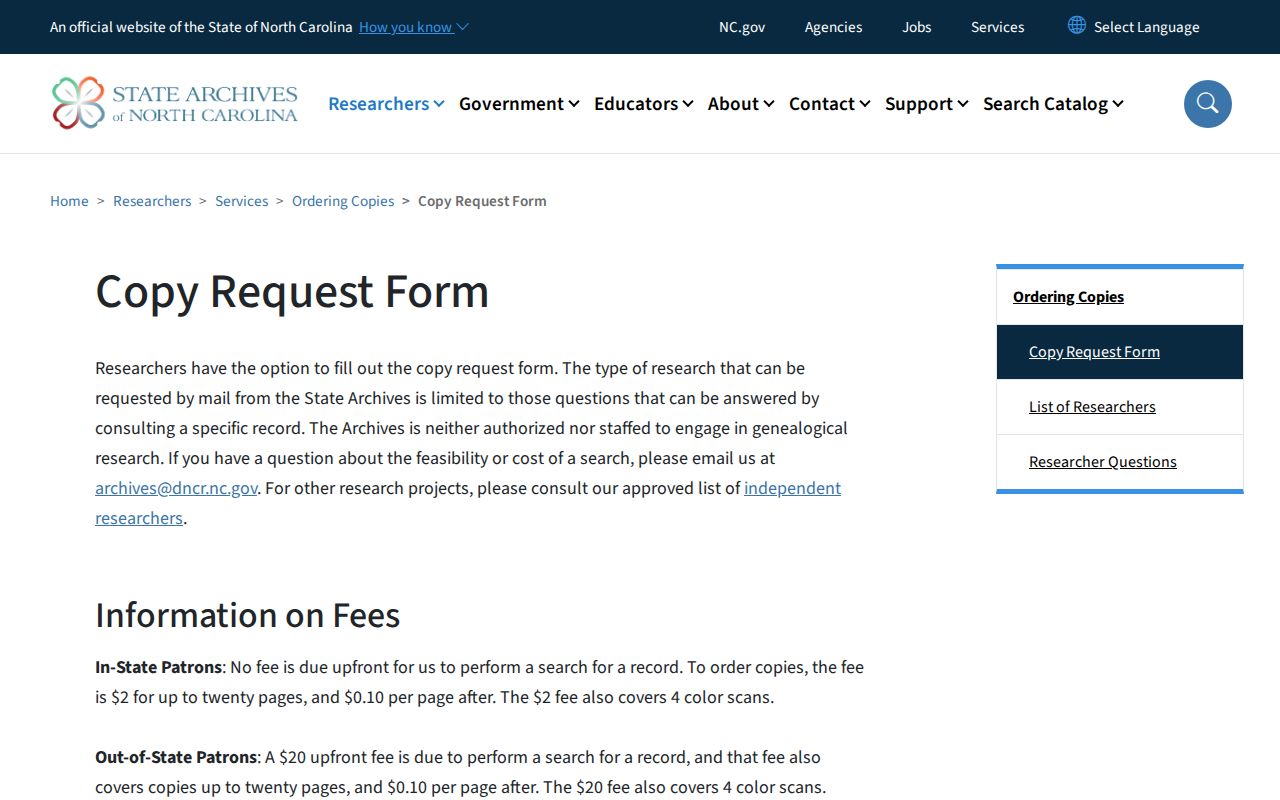
The form shows the structured request channel for older holdings that a Kernersville online search may not display.
Kernersville Previous Residents Limits
Previous residents research is a dated house-history exercise. A tax owner, deed grantee, library listing, court party, obituary subject, or archive entry each says something limited about a person and time. It cannot establish present residence, provide a reason to contact a living person, or defeat a protected address. Keep sensitive vital application fields, protected locations, and identification data out of research notes.
Lawful use. Use Kernersville previous-residents records for family history, estate work, local history, or civic understanding. Do not use any record to stalk, track, harass, or harm another person.
When one source is silent, record the no-match with its date and move to the proper custodian, library, or archive. Silence in one index is not proof that no one lived at the address.